Vadzo Imaging Validates Falcon-900MGS 3MP Sony IMX900 Monochrome Global Shutter USB Camera with Quad HDR for HDR Imaging
The Falcon-900MGS is a 3MP Sony IMX900 global shutter USB camera featuring Quad HDR for extreme-contrast imaging in
Press Release Disclaimer: This is a press release distributed through the XPR Media network. It has not been independently verified by our newsroom.
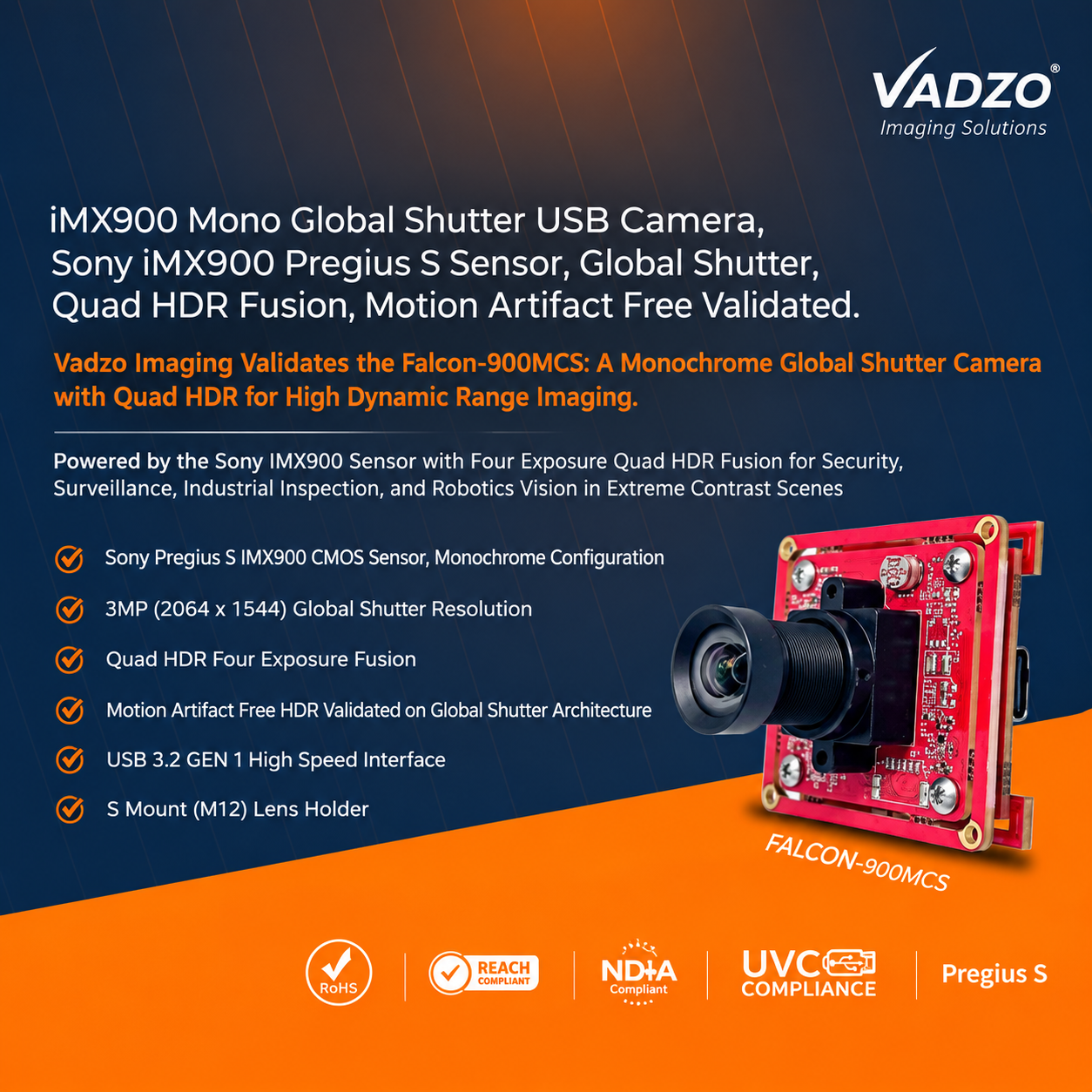

The Falcon-900MGS is a 3MP Sony IMX900 global shutter USB camera featuring Quad HDR for extreme-contrast imaging in security and industrial inspection.
FORT WORTH, TX, UNITED STATES, November 4, 2026 /EINPresswire.com/ — Vadzo Imaging, a provider of embedded vision camera products for OEMs and system integrators, today announces validation of the Falcon-900MGS, an IMX900 Mono Global Shutter USB Camera built on Sony’s 3MP IMX900 sensor. Part of Vadzo’s USB camera portfolio, the Falcon-900MGS combines global shutter imaging with Quad HDR technology to capture high-contrast scenes while maintaining image detail across bright and dark regions.
Designed for security integrators, machine vision engineers, and robotics OEMs, the camera addresses challenging imaging conditions such as backlit entrances, reflective industrial surfaces, and mixed-light environments. Its four-exposure HDR fusion approach extends dynamic range beyond standard and simpler two-exposure HDR techniques. The camera also integrates an onboard ISP and USB 3.2 Gen 1 interface for embedded vision applications requiring high-quality monochrome imaging.
The Challenge of Capturing Extreme Contrast
Standard dynamic range sensors can struggle when a scene contains very bright and very dark regions. Exposing for the highlights can hide details in shadows, while exposing for darker areas can cause bright regions to become overexposed. This can affect security identification, automated inspection, and object detection.
Two-exposure HDR can improve image detail in challenging lighting, but some extreme-contrast scenes may require a wider exposure range. Examples include a person standing in a dark doorway against bright daylight or an industrial component with reflective metal surfaces beside deep recesses.
Multi-exposure HDR also needs to be evaluated carefully when objects move. Combining exposures captured at different times can introduce ghosting or blurred edges. For applications that depend on accurate object boundaries, maintaining motion integrity during HDR processing is important.
How the Falcon-900MGS Uses Quad HDR
The Falcon-900MGS uses the Sony IMX900 3MP monochrome global shutter sensor with Quad HDR technology. The four-exposure fusion approach combines different exposure and gain settings into an output image with extended dynamic range compared with standard imaging or simpler two-exposure HDR techniques.
The IMX900 belongs to Sony’s Pregius S family and uses a global shutter architecture, in which pixels are exposed simultaneously rather than progressively row by row. This architecture supports accurate capture of moving objects and is relevant to applications where image geometry and motion representation matter.
Vadzo has validated the camera’s Quad HDR behavior under high-contrast conditions that include moving subjects. This evaluation addresses the need to assess dynamic range and motion integrity together rather than relying only on static test-chart results.
The camera connects through USB 3.2 Gen 1 and supports full 3MP capture, along with 1080p and 720p output modes for workflows that require different resolution and frame-rate balances. Its operating temperature range is specified from -30°C to 70°C, supporting evaluation in outdoor, warehouse, and industrial environments.
Product Overview
The Falcon-900MGS is an IMX900 Mono Global Shutter USB Camera built on the Sony IMX900 sensor and validated specifically for Quad HDR performance across extreme contrast scenes. As a 3MP Quad HDR USB Camera, it is purpose-built for OEMs who need genuinely extended dynamic range validated together with motion integrity, rather than a dynamic range specification confirmed only under static bench conditions that says nothing about how the camera performs once something in the scene actually moves. The 3MP Global Shutter USB Camera designation reflects Vadzo’s validation of the IMX900 sensor’s global shutter architecture specifically as the foundation the four-exposure fusion process depends on for artifact-free output. The camera module houses the IMX900 sensor, ISP, and USB 3.2 GEN 1 controller in a compact form factor with a standard M12 lens holder, functioning as a Quad Frame HDR USB Camera that ships validated rather than requiring independent dynamic range characterization after delivery. As an IMX900 Quad HDR USB Camera, output modes include full 3MP, 1080p, and 720p, selectable to balance resolution against frame rate and USB bandwidth for the target workflow, and the IMX900 High Dynamic Range USB Camera designation specifically confirms this dynamic range behavior across every output mode. As a 3MP Monochrome Quad HDR USB Camera, the camera enumerates as a standard UVC device on Windows, Linux, and Android, requiring no proprietary drivers for evaluation or production integration.
Key specs: 3MP (2064 x 1544) | Sony Pregius S IMX900 1/3.1-inch 2.25-micron pixel | Monochrome | Global Shutter | Quad HDR | S Mount M12 Lens | USB 3.2 GEN 1 | 3MP / 1080p / 720p | Windows Linux Android | -30°C to 70°C
Key Capabilities of the Sony IMX900 Quad HDR Machine Vision USB
Four-Exposure Quad HDR
Quad HDR combines four exposure and gain combinations to extend the usable dynamic range of captured images. This helps preserve information in bright and dark regions of challenging scenes. It is relevant to applications involving backlighting, reflective surfaces, and mixed illumination, where standard dynamic range or basic two-exposure HDR may not provide sufficient detail.
Global Shutter Motion Capture
The IMX900 global shutter architecture exposes pixels simultaneously, supporting accurate capture of moving subjects without the typical rolling-shutter skew associated with row-by-row readout. Combined with Quad HDR, this provides an imaging platform for applications that require both extended dynamic range and reliable representation of moving objects.
3MP Monochrome Imaging
The camera captures images at 2064 × 1544 resolution. Its monochrome output supports applications that prioritize image intensity, contrast, and edge information. This makes the module suitable for security monitoring, industrial inspection, and machine vision systems that use monochrome image processing.
Multiple Output Resolutions
The Falcon-900MGS supports 3MP, 1080p, and 720p output modes. Full 3MP resolution is suitable for workflows requiring maximum image detail, while lower-resolution modes can help balance bandwidth and frame-rate requirements. Engineers should confirm the supported frame rates for each mode against the camera configuration.
USB 3.2 Gen 1 Integration
The USB 3.2 Gen 1 interface provides a direct connection to compatible host systems. UVC support on Windows, Linux, and Android simplifies evaluation and integration without requiring a proprietary camera interface board for standard UVC operation.
Industrial Operating Temperature Range
With a specified operating temperature range of -30°C to 70°C, the Falcon-900MGS can be evaluated for outdoor security installations, warehouse systems, and industrial environments. OEMs should validate the complete camera assembly within the temperature and enclosure conditions of the intended deployment.
“Security integrators and machine vision engineers need more than a general HDR specification when working with extreme contrast. They need to understand how the camera handles multiple exposures and whether image integrity is maintained when objects move. The Falcon-900MGS combines Sony IMX900 global shutter imaging with Quad HDR, giving OEMs a camera platform to evaluate for demanding lighting conditions and motion-sensitive applications,” said Alwin Vincent, Product Manager, Vadzo Imaging.
Applications for Quad HDR Global Shutter Imaging
Backlit Entryway and Doorway Monitoring
Entryways often contain strong brightness differences between indoor and outdoor areas. A person standing inside a dim entrance against bright daylight can appear as a silhouette in a standard dynamic range image. The Falcon-900MGS can support backlit monitoring systems by capturing additional detail across bright and dark regions, helping security platforms process images in challenging entrance conditions.
High-Contrast Outdoor Security
Outdoor installations encounter changing illumination throughout the day, including direct sunlight, shaded areas, and reflective surfaces. The Falcon-900MGS provides Quad HDR imaging for security systems that need to retain image information across these contrasting regions. Its monochrome global shutter architecture also supports applications that require accurate capture of moving subjects.
Surveillance and Recording Systems
Surveillance cameras may encounter substantial lighting changes between sunrise, midday, dusk, and nighttime operation. The Falcon-900MGS can be evaluated for recording systems that require consistent image detail in mixed-light scenes. Its multiple output modes provide flexibility when integrating the camera into different monitoring and recording workflows.
Industrial Inspection
Industrial inspection scenes can combine reflective metal surfaces with dark recessed areas, creating challenging exposure conditions. The Falcon-900MGS supports these applications through monochrome imaging and Quad HDR, helping inspection systems retain image information across contrasting surface regions. Its global shutter architecture is also relevant to inspection processes involving moving components.
Robotics and Machine Vision
Robotics platforms may operate across areas with different lighting conditions, requiring consistent image input for detection and guidance systems. The Falcon-900MGS combines global shutter imaging with Quad HDR for applications that need motion capture and extended dynamic range. OEMs should evaluate the camera’s output modes and performance against the movement speed and lighting conditions of their specific platforms.
Frequently Asked Questions
Q: What is Quad HDR and how is it different from standard two exposure HDR?
A: Vadzo Imaging designs this camera around a four-exposure fusion technique that combines four separate exposures and gain combinations into a single output frame, extending usable dynamic range further than a standard two-exposure HDR approach can reach. Vadzo Imaging validates this specifically because scenes with truly extreme contrast, such as a backlit doorway or a reflective industrial surface next to a dark recess, frequently exceed what two exposures alone can adequately resolve. Vadzo Imaging considers this distinction meaningful enough that OEMs should confirm exposure count directly rather than relying on a general HDR label to predict performance.
Q: Does combining four exposures into one frame introduce motion blur or ghosting artifacts?
A: No. Vadzo Imaging validates this camera’s four-exposure fusion process together with its global shutter architecture, which exposes every pixel simultaneously across all four exposures rather than capturing them sequentially over time. Vadzo Imaging confirms this combination specifically to avoid the ghosting and edge blurring artifacts that a rolling shutter or a sequentially captured multi-frame HDR technique would introduce the moment anything in the scene moves.
Q: What kinds of scenes benefit most from Quad HDR imaging?
A: Vadzo Imaging designs this camera for scenes containing both very bright and very dark regions within the same frame, such as a backlit entryway, an outdoor area combining direct sun and shadow, or an industrial surface combining reflective and recessed regions. Vadzo Imaging validates that this four-exposure technique resolves detail across both extremes simultaneously, which a standard dynamic range sensor or a basic two-exposure HDR technique cannot fully achieve in genuinely high contrast conditions. Vadzo Imaging recommends this camera specifically for deployments where a lower dynamic range solution has previously produced silhouetted subjects or blown-out backgrounds.
Q: Does using Quad HDR reduce the camera’s frame rate significantly?
A: Vadzo Imaging validates practical frame rates with Quad HDR active across all supported output resolutions, and also provides 1080p and 720p modes for applications that prioritize frame rate alongside extended dynamic range. Vadzo Imaging positions this selectable output specifically so OEMs can choose the resolution and frame rate balance their application actually requires without sacrificing the dynamic range performance Quad HDR provides.
Q: Why should OEMs building high contrast vision applications choose Vadzo Imaging as their camera supplier?
A: Vadzo Imaging offers more than a camera module built around a capable sensor. OEMs building high-contrast vision applications and working with Vadzo Imaging receive a camera validated for genuine four-exposure Quad HDR performance together with global shutter motion integrity, along with engineering support covering lens selection, firmware customization, and dynamic range characterization guidance. Vadzo Imaging maintains evaluation kits with no minimum order requirement, so engineering teams can confirm Quad HDR performance across their own representative high-contrast scenes before committing to volume production. This combination of validated dynamic range performance and low minimum evaluation access is why security and industrial OEMs continue to choose Vadzo Imaging for high contrast vision camera programs, and Vadzo Imaging extends the same validation discipline across its broader monochrome global shutter lineup for OEMs whose deployment spans multiple contrast and lighting conditions.
Availability
The Falcon-900MGS IMX900 Mono Global Shutter USB Camera is available for evaluation and production orders. OEMs and system integrators can request an evaluation unit to assess Quad HDR performance using their own high-contrast scenes and moving subjects.
For evaluation requests, product information, or OEM integration discussions, contact support@vadzoimaging.com or visit the Vadzo Imaging website.
About Vadzo Imaging
Vadzo Imaging is a global provider of embedded vision solutions, offering camera technologies and imaging platforms for robotics, industrial automation, UAVs, edge AI, and medical systems. Its products are designed for integration with embedded platforms including NVIDIA Jetson, Rockchip, Raspberry Pi, and NXP i.MX. Vadzo supports customers through hardware customization, firmware development, and module-level drivers across USB, MIPI, GigE, Wi-Fi, and SerDes camera interfaces.
Alwin Vincent
Vadzo Imaging
+1 817-678-2139
alwin@vadzoimaging.com
Visit us on social media:
LinkedIn
YouTube
X
Legal Disclaimer:
EIN Presswire provides this news content “as is” without warranty of any kind. We do not accept any responsibility or liability
for the accuracy, content, images, videos, licenses, completeness, legality, or reliability of the information contained in this
article. If you have any complaints or copyright issues related to this article, kindly contact the author above.

Media gallery